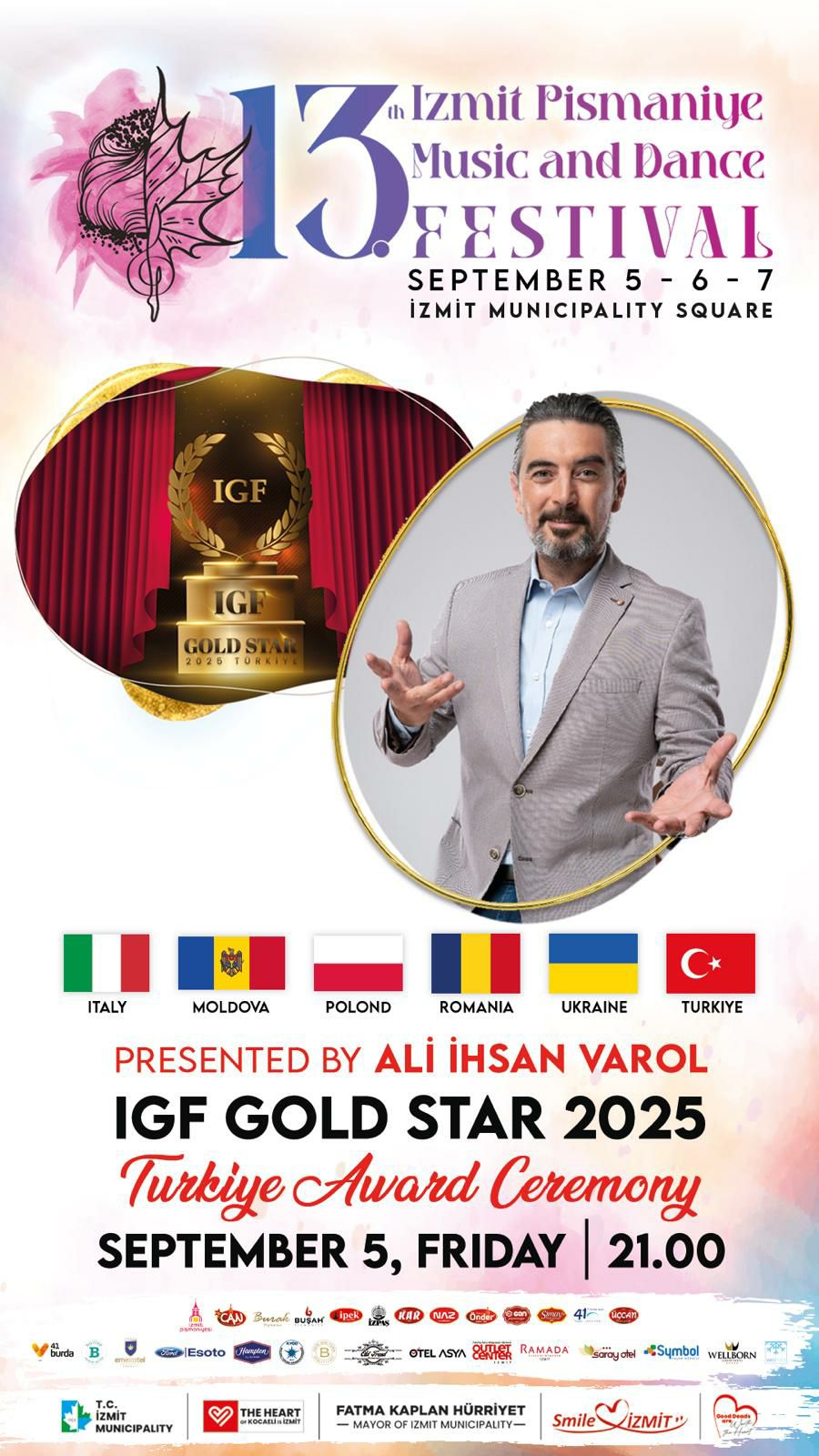

Gold Star (ex. OSCAR ) 2025 of WORLD FOLKLORE UNION IGF
IZMIT- TURKEY
Each year, every National Federation affiliated with the International Folklore Group (IGF) submits to the Executive Board a single nomination, regarded as its most significant proposal, for the awarding of the IGF GOLD STAR Trophy. In accordance with the official regulations, the distinction may be conferred upon artists, researchers, writers, artistic directors, choreographers, and visual artists—individuals whose professional activity has demonstrably contributed to the promotion, preservation, and advancement of the values of traditional folk culture.
The award ceremony is held annually in a different host country. Laureates walk the red carpet, welcomed by the hosts, national authorities, and members of the IGF Executive Board. The laudatio moment is illustrated through a three-to-four-minute video presentation, while the performance of each laureate’s national anthem transforms the stage into a profoundly moving tableau of cultural dignity and respect. Brief words of gratitude, addressed to a large and attentive audience, complete the ceremonial elegance and solemnity of the event.
Over the past two decades, the IGF GOLD STAR Gala has reached outstanding artistic standards in major cities across Italy, France, Israel, Romania, Cyprus, and other countries, thereby consolidating the international prestige and symbolic value of this distinction.
The 2025 Edition: Izmit, Turkey
In 2025, the Municipality of Izmit will host the most significant event in the IGF annual calendar. The organization of the gala is coordinated by the Turkish Folklore Federation, under the leadership of Mr. Murat Huriyet, member of the IGF Executive Board, who has announced extensive preparations for welcoming the international delegations.
Artistic delegations from twenty countries are expected to attend, participating in the award ceremony, official IGF working meetings, and a comprehensive accompanying program that includes exhibitions, practical workshops, and folklore performances presented by renowned ensembles from Turkey, Romania, and Ukraine.
On the specially designed stage of the IGF GOLD STAR 2025 Gala, representatives of the National Folklore Federations of
Italy, Poland, Ukraine, Romania, the Republic of Moldova, and Turkey will take part in this celebration of cultural excellence.
Meeting of the IGF Executive Board – The “Cununa de pe Someș” Case on the International Agenda
The Executive Board of the International Folklore Group (IGF) convened in Izmit, addressing a series of matters of major importance for the years 2025 and 2026. The meeting, chaired by IGF President Dorel Cosma, comprised presentations and in-depth discussions concerning recent international cultural events and initiatives.
Robert László—First Vice President of the National Folklore Association of Romania and member of the IGF Executive Board—presented the outcomes of the event held in Satu Mare, entitled “Closer Through Literature and Folklore.” This initiative culminated in the publication of the international volume “Fabrics of Words,” an anthology bringing together the works of thirty-three writers from across the globe. Murat Hurriyet reported on the success of the cultural events organized in Izmit, emphasizing the exemplary collaboration between IGF and local authorities within the framework of the IGF Gold Star program.
The Board also announced forthcoming key destinations and projects: Israel, presented by Vice President Amen Kassem; France, introduced by Deputy President Nicholas Charlety; and, for the year 2026, Poland and Slovakia, presented by Vice President Malgosa Broda and Josef Revak. The financial status of the organization was detailed by Treasurer René Sourisso and his Deputy, Pahone Pop.
A particularly significant focus of the deliberations concerned IGF’s responsibility to safeguard authentic values of traditional culture and to firmly oppose abusive political interference. In this context, the dissolution of the professional folk ensemble “Cununa de pe Someș” from Bistrița, Romania, was unanimously characterized as an abnormal and abusive act, constituting a severe blow to cultural heritage. This ensemble—highly regarded for its artistic excellence, professionalism, and consistent presence on international IGF stages—was disbanded as a result of a political decision, under the unfounded and misleading pretext of a so-called “transition to amateur status.”
Consequently, the IGF resolved to draft and submit an international letter of protest addressed to the Government of Romania and the Presidency of Romania, as well as to the European Commission, France, Italy, and the United States of America, calling for the immediate cessation of this abuse.
The message conveyed by the IGF Executive Board is unequivocal:
“By saving today the ensemble Cununa de pe Someș, we are, in fact, safeguarding global folk culture from political interference and brutality.”
The IGF Cultural Triangle: EAST – WEST – ASIA
Within the framework of the cultural events organized in Izmit, Turkey, a highly significant meeting took place between three mayors who have established official branches of the International Union of Folklore (IGF) in their respective cities: Filippo Barbano, Mayor of San Giovanni Rotondo (Italy); Fatma Kaplan Hurriyet, Mayor of Izmit (Turkey); and Vitalie Vrabie, Mayor of Ungheni (Republic of Moldova). Together with the President of IGF, Dorel Cosma, the three mayors convened in the elegant office of the Mayor of Izmit, where they formally signed a protocol of priority cultural cooperation, symbolically entitled “The IGF Cultural Triangle: East – West – Asia.”
The protocol stipulates the organization of international cultural meetings in each of the three designated centers, during which fundamental aspects of the evolution of culture at a global level will be presented, examined, and critically discussed. The planned program includes exhibitions, academic symposia, book launches, and joint cultural initiatives carried out in collaboration with IGF member countries.
In Izmit, the process of establishing an International Museum of Folk Art has already begun, with Romania contributing the first donated exhibits. In San Giovanni Rotondo, work is underway to finalize the permanent IGF headquarters, which will comprise a dedicated performance hall, a museum, and an open-air amphitheater. In Ungheni, local authorities are preparing a museum with comparable international characteristics, alongside the creation of an International Library dedicated to the cultural heritage and scholarly contributions of IGF member states.
This joint initiative also serves as an open invitation and a strong signal to other countries that have already expressed their intention to join the IGF Cultural Triangle. The expansion and consolidation of this cultural framework will be further discussed and developed during upcoming international IGF meetings.
